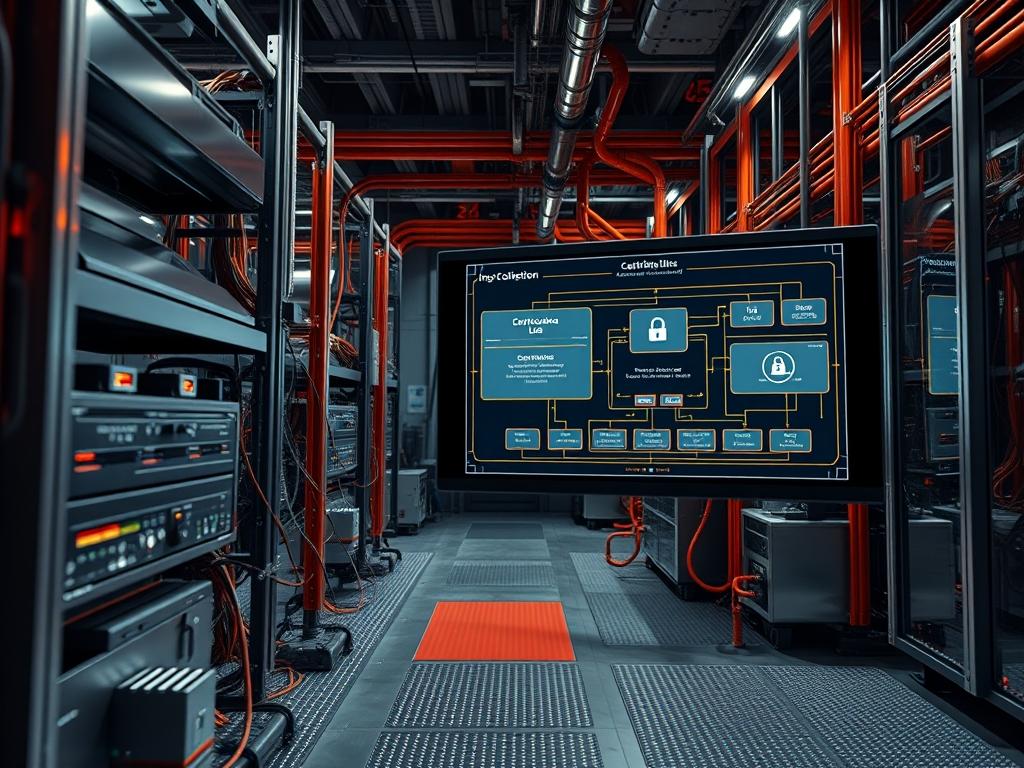
Certificate revocation lists (CRLs) serve as a foundational trust validation mechanism in modern network infrastructure. Within the context of enterprise cloud environments and industrial control systems, these lists provide a binary status check for all issued X.509 certificates that have been invalidated before their scheduled expiration date. The primary architectural problem stems from the cumulative nature of CRL expansion: as more certificates are revoked, the binary file size increases linearly. This growth puts immense pressure on network throughput and increases the latency of every initial TLS handshake. High latency in fetching these lists can result in application-level timeouts that mimic packet-loss or total service failure. This manual provides a systematic approach to optimizing certificate revocation lists through intelligent caching, delta mechanisms, and infrastructure hardening. By streamlining the delivery of these lists, architects can ensure that security checks do not become a bottleneck for high-concurrency applications or remote edge nodes suffering from signal-attenuation.
TECHNICAL SPECIFICATIONS (H3)
| Requirement | Default Port/Operating Range | Protocol/Standard | Impact Level | Recommended Resources |
| :— | :— | :— | :— | :— |
| CRL Distribution Point (CDP) | TCP Port 80 / 443 | RFC 5280 / HTTP(S) | 9 | 4 vCPU / 8GB RAM |
| Delta CRL Support | N/A | X.509 v3 | 7 | High-speed NVMe Storage |
| OCSP Stapling | TCP Port 443 | RFC 6960 | 8 | 10Gbps NIC |
| NTP Synchronization | UDP Port 123 | RFC 5905 | 10 | Low-latency Clock Source |
| Directory Access | TCP Port 389 / 636 | LDAP / LDAPS | 6 | Minimum 2GB RAM |
THE CONFIGURATION PROTOCOL (H3)
Environment Prerequisites:
Systems must be running OpenSSL 3.0 or higher to support modern hashing algorithms. The Certificate Authority (CA) requires root or sudoer permissions to write to the CRL distribution directory. All network nodes must adhere to IEEE 802.1Q for VLAN tagging if the CRL traffic is isolated to a management plane. Ensure that the system clock is synchronized via a Stratum 1 or 2 NTP server; clock skew exceeding 60 seconds will invalidate the CRL signature and halt all authentication flows.
Section A: Implementation Logic:
The engineering design for efficient CRL management relies on the concept of encapsulation and delta reduction. Instead of forcing a client to download a multi-megabyte payload for every validation, we utilize a base CRL and a series of smaller delta files. The base CRL is generated on a long-term cycle (e.g., weekly), while the delta CRL contains only the serial numbers revoked since the last base update. This reduces the overhead on the network interface and prevents thermal-inertia issues in high-density server racks by reducing CPU cycles spent on parsing large ASN.1 structures. By implementing idempotent deployment scripts, architects ensure that the distribution points always serve the most current list without manual intervention or configuration drift.
Step-By-Step Execution (H3)
1. Initialize the CRL Configuration File
Modify the /etc/ssl/openssl.cnf file to define the CRL distribution points (CDP) and the update frequency. Locate the [ v3_ca ] section and add crlDistributionPoints = URI:http://crl.example.com/production.crl.
System Note: This action updates the metadata of all newly signed certificates. The kernel does not process this directly, but the OpenSSL binary uses this configuration to inject the URI into the Subject Alternative Name (SAN) or Extension fields of the X.509 payload.
2. Generate the Base Revocation List
Execute the command openssl ca -gencrl -out /var/www/html/crl/production.crl -config /etc/ssl/openssl.cnf.
System Note: This process reads the CA database (usually a flat file or SQL backend) and compiles all revoked serial numbers into a DER-encoded file. It involves high disk I/O as the CA checks each entry for expiration against the current system time.
3. Establish File Permissions and Ownership
Apply strict access controls using chown www-data:www-data /var/www/html/crl/production.crl and chmod 644 /var/www/html/crl/production.crl.
System Note: Using chmod ensures the web server can read the file while preventing unauthorized modification. This protects the integrity of the revocation data at the filesystem level, even if the application layer is compromised.
4. Configure Web Server Caching Headers
In the Nginx configuration, add location ~* \.crl$ { add_header Cache-Control “public, max-age=3600”; } and restart the service via systemctl restart nginx.
System Note: This instructs the kernel to prioritize these static files in the page cache. By setting a specific TTL (Time To Live), you reduce the concurrency load on the disk subsystem, shifting the burden to the network stack and improving overall throughput.
5. Validate CRL Integrity and Path
Run openssl crl -in /var/www/html/crl/production.crl -text -noout to verify the content.
System Note: This command parses the ASN.1 structure and displays the last update and next update fields. If the “Next Update” time is in the past, the system will trigger a validation failure on all client machines.
Section B: Dependency Fault-Lines:
The most common failure in certificate revocation lists distribution is a “circular dependency” during the TLS handshake. If the CRL is hosted on an HTTPS server that requires a CRL check to establish its own connection, the process will hang. Always host CRLs on plain HTTP or ensure the CDP server certificate has the “CRL Distribution Point” extension omitted to prevent a deadlock. Another bottleneck is the disk throughput of the CA server. If the CA database grows to hundreds of thousands of entries, the generation of the CRL becomes a heavy compute task, potentially leading to timeouts and signal-attenuation in the delivery pipeline.
THE TROUBLESHOOTING MATRIX (H3)
Section C: Logs & Debugging:
When a client fails to download a CRL, check the system logs at /var/log/nginx/access.log or /var/log/apache2/access.log. Look for HTTP 404 errors (file not found) or 403 errors (permission denied). If the server returns a 200 OK but the client still fails, the issue is likely a MIME type mismatch. Ensure the server identifies .crl files as application/pkix-crl.
On the client side, use the command curl -vI http://crl.example.com/production.crl to check headers. If you see a “Content-Length” that is unexpectedly small, the CRL may have been truncated during generation. In environments using hardware security modules (HSMs), check the HSM logs for “Signature Failure” codes, which indicate the CA’s private key was unable to sign the CRL payload due to a session timeout or hardware fault. Physical cues on the server rack, such as amber lights on the NIC, can indicate packet-loss caused by a saturated backplane during peak CRL synchronization windows.
OPTIMIZATION & HARDENING (H3)
– Performance Tuning: To handle high concurrency, implement a Content Delivery Network (CDN) to cache the CRLs at the edge. This reduces the latency for geographically dispersed clients and offloads the traffic from the root CA infrastructure. Enable Gzip or Brotli compression on the web server to minimize the payload size during transit, though ensure clients can handle compressed ASN.1 data.
– Security Hardening: Implement a firewall rule via iptables or nftables to restrict access to the CRL distribution point if the PKI is internal only. Use lsattr +i on the CRL file between update cycles to prevent any unauthorized modification, making the file immutable until the next scheduled generation script runs.
– Scaling Logic: As the infrastructure expands, transition from a single CRL to partitioned CRLs. This involves dividing the revoked certificates into multiple lists based on the serial number range. This is an idempotent way to scale: as the population of certificates grows, you simply add more partitions without increasing the size of any single file. This maintains high throughput and prevents the validation process from exceeding the 100ms latency threshold required by most real-time systems.
THE ADMIN DESK (H3)
What happens if the CRL becomes too large for my IoT devices?
Switch to Delta CRLs or OCSP stapling immediately. Large CRL payloads cause signal-attenuation issues on low-power wide-area networks. Delta CRLs only transmit changes: drastically reducing the required throughput for memory-constrained edge devices during the validation phase.
How do I fix the “CRL Expired” error on all clients?
Verify the system time on the CA server and re-run the gencrl command. Ensure the cron job or systemd timer responsible for CRL generation has the necessary permissions to use the CA private key and write to the output directory.
Can I use HTTPS for my CRL Distribution Point?
While possible, it is not recommended due to the potential for circular dependency loops. If the client needs to check the CRL to trust the HTTPS connection of the CDP, the validation will fail. Use HTTP for maximum compatibility and performance.
Why is my CRL generation taking so long?
The overhead is likely caused by a massive CA database. Clean up expired certificates from the database or implement CRL partitioning. Optimized database indexing on the serial number column can also significantly improve the generation throughput and reduce latency.